
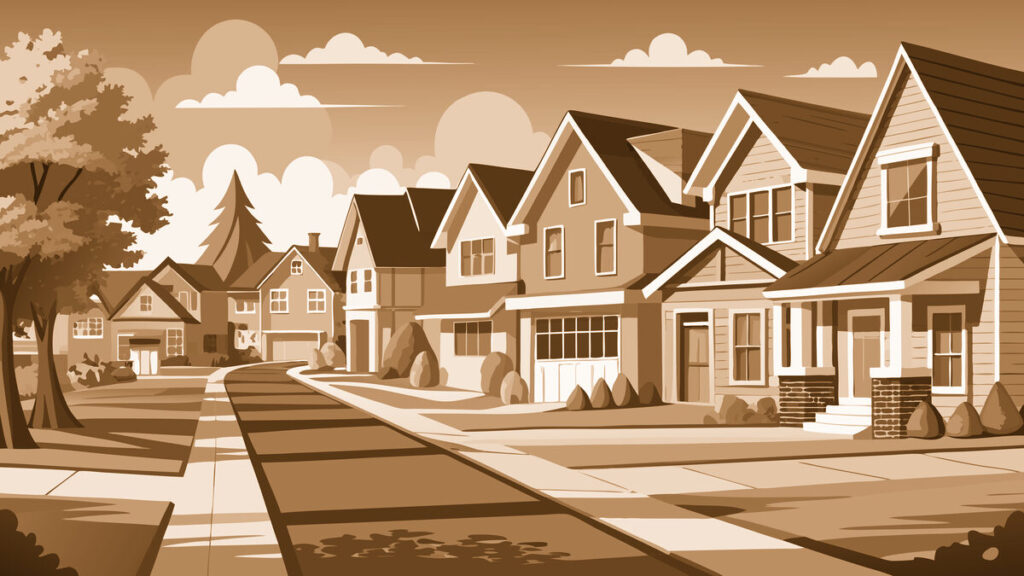
A Quiet Enclave with a Larger Story
Villa Montelena is one of those Upland neighborhoods that can feel pleasantly self-contained while still being closely connected to the city around it. Tucked along West 16th Street between Mountain Avenue and San Antonio Avenue, the gated community is home to 73 residences, shared pools and spas, tennis courts, mature landscaping, and broad views toward the San Gabriel Mountains and Mount Baldy.
Unlike Upland’s older neighborhoods, where Victorian homes, citrus-era packinghouses, and historic commercial buildings tell the story at a glance, Villa Montelena reflects a later chapter in local history. Its heritage is rooted in the transformation of northern Upland from agricultural land into carefully planned suburban neighborhoods during the late twentieth century.
Today, the community is known for its quiet internal streets, single-level homes, mountain outlooks, and convenient location. But to understand what makes Villa Montelena special, it helps to look first at the much older landscape beneath it.
Before Villa Montelena: Upland’s Agricultural Beginnings
Long before streets such as Via Serana, Calle Del Sol, El Mirador, and Via Maria were laid out, the Upland area was home to the Tongva people. During the late nineteenth century, the region became part of the Ontario Model Colony, an ambitious agricultural settlement associated with Canadian developers George and William Chaffey.
The Chaffey brothers helped establish the irrigation systems and street plan that shaped the communities of Upland and Ontario. Their most visible legacy is Euclid Avenue, the unusually broad north-south boulevard designed with a central greenway and rows of trees. Water brought from the foothills made large-scale agriculture possible, and citrus orchards eventually became the foundation of Upland’s economy.
The community went through several names during its early years, including North Ontario and Magnolia. The name “Upland” gained favor because the settlement sat on higher ground than Ontario. Upland incorporated as a city in 1906, by which time lemon groves, packing operations, schools, churches, and civic buildings had already created a strong local identity.
Villa Montelena is not a citrus-era neighborhood, but it occupies land within that larger agricultural landscape. The nearby streets still follow the practical grid established during the colony period, while the neighborhood itself represents the later subdivision of former orchard and open land.
How Villa Montelena Got Its Name
The name Villa Montelena appears to be a developer-selected community name rather than one tied to a documented historic estate or individual. Public neighborhood materials identify Villa Montelena as a homeowners association, but they do not record a specific person, family, or older ranch called “Montelena.”
The name has the romantic quality common to planned communities of the 1980s. “Villa” suggests a private residential retreat, while “Montelena” evokes the nearby mountains and the elevated setting of northern Upland. It is easy to see why the name suits the neighborhood: from many homes and common areas, the San Gabriel Mountains provide a dramatic backdrop, especially on clear winter days when Mount Baldy is snow-capped.
In that sense, the name captures something real about the place even if it does not point to a specific historic origin. Villa Montelena was designed to feel secluded, scenic, and gracious—an enclave connected to Upland but set apart from the busier roads beyond its gates.
The Neighborhood Takes Shape in the 1980s
Property records and real estate histories place many Villa Montelena homes in the early-to-mid 1980s. Individual residences show construction dates around 1982 and 1986, indicating that the community developed during a period when Upland was expanding northward and westward with new planned residential projects.
This period marked a major change across the Inland Empire. Citrus remained part of the region’s identity, but orchards were increasingly replaced by homes, schools, shopping centers, golf courses, and landscaped residential developments. Families were drawn to Upland for its foothill location, established streets, access to major roads, and reputation as a comfortable suburban community.
Villa Montelena fit that moment well. Rather than offering large lots surrounded by working groves, it provided a more compact and managed setting. The neighborhood’s private streets, gates, recreation facilities, and association-maintained landscaping created a lifestyle centered on convenience and shared amenities.
The nearby Upland Hills Country Club also opened in 1983, adding to the area’s recreational character and reinforcing the appeal of north Upland as a place for planned residential living.
Streets and Places That Define the Setting
West 16th Street is the neighborhood’s principal address and an important local reference point. Villa Montelena sits between Mountain Avenue and San Antonio Avenue, close enough to nearby shopping and services while remaining sheltered from through traffic.
Inside the community, street names such as Via Serana, Calle Del Sol, El Mirador, and Via Maria contribute to the neighborhood’s resort-like atmosphere. They are a departure from Upland’s numbered streets and avenue grid, creating the feeling of a small private village within the larger city.
The surrounding area offers several reminders of Upland’s community-oriented character:
- Magnolia Park, near West 15th Street, provides open space and places for neighborhood gatherings.
- McCarthy Park, on North San Antonio Avenue, serves local families with recreational facilities.
- San Antonio Park, farther north at Mountain Avenue and 24th Street, includes ball fields, picnic areas, a playground, and the historic San Antonio Heights Railroad Company waiting station.
- Euclid Avenue, to the east, remains Upland’s defining historic boulevard and one of the clearest surviving links to the city’s citrus-colony origins.
The nearby waiting station is particularly meaningful because it recalls the days when streetcars and local rail lines connected Upland’s neighborhoods, citrus districts, and foothill communities. It is a reminder that transportation and agriculture once shaped daily life here just as strongly as freeways and automobiles do today.
How Villa Montelena Has Evolved
Over the decades, Villa Montelena has matured from a new subdivision into an established neighborhood with its own landscape and traditions. Young plantings have become mature trees, gardens have filled out, and homes have been remodeled to reflect changing tastes and lifestyles.
The community’s original design remains visible in its single-level residences, internal walks, private recreational areas, and carefully maintained common grounds. At the same time, the neighborhood has adapted to modern expectations. Association materials now reference online payments, maintenance requests, and updated amenities, while real estate descriptions mention features such as pools, spas, tennis, picnic areas, and even pickleball.
What has not changed is the sense of place. Residents still enjoy the contrast between a peaceful neighborhood interior and the active city beyond the gates. A short drive connects Villa Montelena to grocery stores, local restaurants, schools, parks, Upland Hills, and the historic civic core.
A Modern Neighborhood with Deep Local Roots
Villa Montelena may not contain one of Upland’s officially designated historic buildings, but its story is still part of the city’s heritage. It represents the moment when an agricultural foothill town became a mature suburban city while retaining its mountain setting and community spirit.
The neighborhood’s history is written less in old façades than in its relationship to the surrounding landscape: the citrus country that came before it, the broad streets established by the Chaffey brothers, the nearby parks and railroad remnants, and the mountain views that continue to define north Upland.
For longtime residents, that combination is what makes Villa Montelena special. It is private without being isolated, modern without being disconnected, and comfortable without losing sight of the older Upland that made the neighborhood possible.